
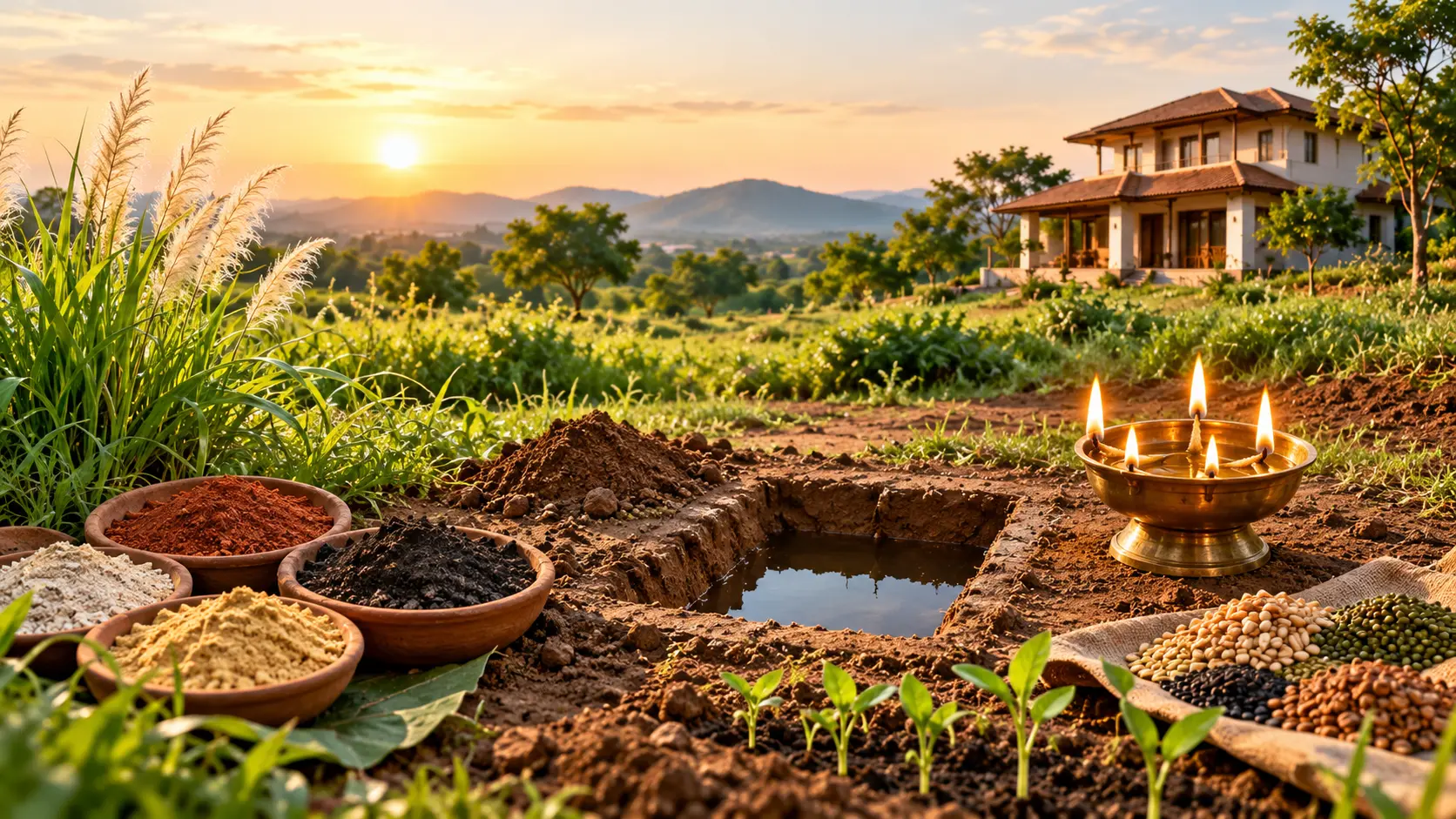
A suitable place of residence is an important consideration in traditional Indian Vastu Shastra. Before constructing a house, practitioners examine the land's soil characteristics, vegetation, geographical setting, and surrounding environment. Traditional texts describe different land classifications and link specific characteristics to suitability for residence, prosperity, agriculture, and other uses.
Land selection is treated as a preliminary step in building construction. A person seeks a suitable place of shelter according to individual needs and circumstances. Traditional Vastu therefore considers the land's nature before planning and constructing a building.
Several classification methods are described, including those based on soil colour, smell, taste, and vegetation. Other classifications consider the wider geographical region, its natural resources, the character of its settlements and its agricultural or defensive advantages.
1. Classification of Land by Soil Colour
Traditional Vastu literature associates soil colour with the four varnas. Two formulations of this classification are found in the traditional descriptions.
One classification identifies white soil with Brahmani land, red soil with Kshatriya land, green soil with Vaishya land and black soil with Shudra land.
Another classification, associated with works including the Samarangana Sutradhara, describes white, red, yellow and black land as suitable, respectively, for Brahmins, Kshatriyas, Vaishyas and Shudras.
These are distinct formulations. The green-soil classification should not silently replace the yellow-soil classification.
Within this traditional framework, soil colour is one characteristic used to assess land suitability for different resident categories.
2. Classification of Land by Vegetation
Traditional Vastu Shastra also uses the types of grasses and plants that grow naturally on a plot of land to classify it. Different plants are associated with different land categories:
- Kusha (sacred grass): Associated with Brahmani land.
- Munj or Shara (types of tall grass): Associated with Kshatriya land in one traditional classification.
- Durva (a low-growing, spreading grass): Associated with Vaishya land in the classification described in the Brihat Samhita.
- Kasha (a tall grass with feathery flower heads): Also associated with Vaishya land in one version of the classification.
- Kusha and Kasha growing together: Mentioned in another description of vegetation associated with Vaishya land.
- Grasses in general: Associated with Shudra land in one classification.
The Vishvakarmaprakasha gives a different arrangement. It describes land containing kusha as suitable for Brahmins, land containing durva for Kshatriyas, land containing fruits, flowers and creepers for Vaishyas, and land containing grasses for Shudras.
These differences demonstrate that vegetation-based classifications vary between traditional texts. Therefore, understand the characteristics according to the classification being discussed.
3. Classification of Land by Smell and Taste
The smell and taste attributed to soil are also considered in traditional land assessment.
One classification associates fragrant soil and a sweet taste with Brahmani land; a blood-like smell and an astringent taste with Kshatriya land; a grain-associated smell and a sour taste with Vaishya land; and a honey-associated smell and a bitter taste with Shudra land.
Another formulation associates the smells of ghee, blood, grain and honey with Brahmins, Kshatriyas, Vaishyas and Shudras, respectively.
The taste classifications also differ between descriptions. One account associates sweet taste with Brahmins, pungent taste with Kshatriyas, bitter taste with Vaishyas and astringent taste with Shudras.
These classifications reflect different traditional formulations rather than a single, universally consistent list. Soil should not be tasted as part of a modern site investigation.
4. Traditional Outcomes Associated with the Four Categories
Traditional descriptions associate different outcomes with the four land categories.
Brahmani land is associated with happiness and comfort. Kshatriya land is associated with rulership or authority. Vaishya land is associated with wealth and agricultural abundance. Shudra land is described as unsuitable for residence in one particular classification.
These associations belong to the traditional social and symbolic framework of Vastu Shastra. They are not established predictions of a person’s prosperity, status or future circumstances.
5. Three Geographical Types of Land
The Samarangana Sutradhara describes three broad geographical categories: Jangala, Anupa and Sadharana. These classifications concern the wider environment, not soil colour alone.
Jangala land
The following features characterise Jangala land:
- Water is relatively distant.
- Sand is abundant.
- Small thorny trees are present.
- The winds are dry, hot and strong.
- The soil is described as black.
The description emphasises a comparatively dry and hot environment.
Anupa land
Anupa land is described through contrasting characteristics:
- Water is available nearby.
- The surroundings are moist, low-lying and cool.
- It mentions fish, meat, and rivers.
- Beautiful, smooth and tall trees are abundant.
This category is associated with a comparatively moist environment and the presence of water.
Sadharana land
Sadharana land combines characteristics of the preceding geographical types. It is described as a region that is neither excessively hot nor excessively cold.
These three categories provide a traditional framework for describing a building site's broader geographical setting.
6. Sixteen Traditional Types of Land
The Samarangana Sutradhara, associated with Maharaja Bhoja, describes sixteen types of land, each with distinct characteristics. These classifications concern prosperity, agriculture, natural resources, settlements, commerce and defence.
6.1 Balishsvamini
Balishsvamini land is described as beautiful and prosperous, inhabited by respectable people and suitable for rule by a capable king.
6.2 Land associated with contributions of produce
One description concerns land where people contribute a substantial share of their agricultural produce. Its precise technical classification requires confirmation from the original Sanskrit wording.
6.3 Sitagocararaksini
This land has abundant rivers and streams, both within and beyond mountainous areas. It also mentions its boundaries and territorial divisions.
6.4 Apashrayavati
Apashrayavati land contains frightening rivers, mountains and forests. It is described as unsuitable for human habitation.
6.5 Kanta
Kanta land is attractive, with mountains, rivers and groves. People are eager to live there.
6.6 Khanimati
Khanimati land contains mines of metals such as gold and silver and is associated with abundant salt production.
6.7 Atmadharini
Widely spread settlements characterise Atmadharini land. Its inhabitants are not easily influenced through inducements involving punishment, wealth or positions in a royal court.
6.8 Vanikprasadita
Vanikprasadita land is associated with well-known goods and commercial activity, particularly trade connected with Vaishyas.
6.9 Dravyavati
Dravyavati land contains useful trees and plant materials. The named vegetation includes shak, ashvakarna, khadira, shriparni, syandana, asana, bamboo, vetra and shara.
6.10 Amitraghatini
Amitraghatini land has well-organised settlements, a peaceful environment and inhabitants who maintain friendly relations with one another.
6.11 Ashrayipurusha
Ashrayipurusha land is described as free of prisoners and populated by disciplined, well-mannered people.
6.12 Shakyasamanta
Shakyasamanta land is associated with subordinate or regional rulers described as disengaged from counsel and energetic action.
6.13 Devamatrika
Devamatrika land is irrigated by river water, so cultivation does not depend on waiting for rainfall.
6.14 Dhanya or Dhanyashalini
Dhanya or Dhanyashalini land produces abundant crops from sown seeds with little effort. Its ploughed fields are also described as not being destroyed by floods and similar natural calamities.
6.15 Hastivanopeta
Hastivanopeta is a mountainous territory with elephant-inhabited forests. It is associated with increasing a king’s military strength.
6.16 Suraksha
Suraksha land is protected by difficult mountains and rivers, making it hard for enemies to control.
These classifications describe different characteristics of the wider territory: some concern agricultural productivity, others natural resources, settlement patterns, commerce or strategic advantages.
7. Land Quality and Plant Growth
The traditional view attributed to Varaha considers land favourable when a planted seed or sapling grows well. Vegetation growth is treated as an indicator of the land’s desirable characteristics.
Kusha, shara, durva and kasha are among the grasses mentioned in traditional land classification. Their presence depends on the classification being followed.
The Brihat Samhita also describes favourable land through auspicious creepers and trees, pleasant fragrance, a sweet quality and the absence of certain defects. Such land is described as a place where a person can rest briefly, recover from travel fatigue, and experience tranquillity and happiness.
These characteristics combine the site's natural conditions with its traditional suitability for habitation.
8. From Land Selection to Determining Directions
Traditional land selection precedes building planning. Once suitable land has been selected, a central sama-mandala is used to determine directions.
This step belongs to the subsequent stage of site planning rather than to soil classification itself.
The traditional approach therefore moves from examining the land’s characteristics to establishing the directions needed for building layout.
0 Comments