
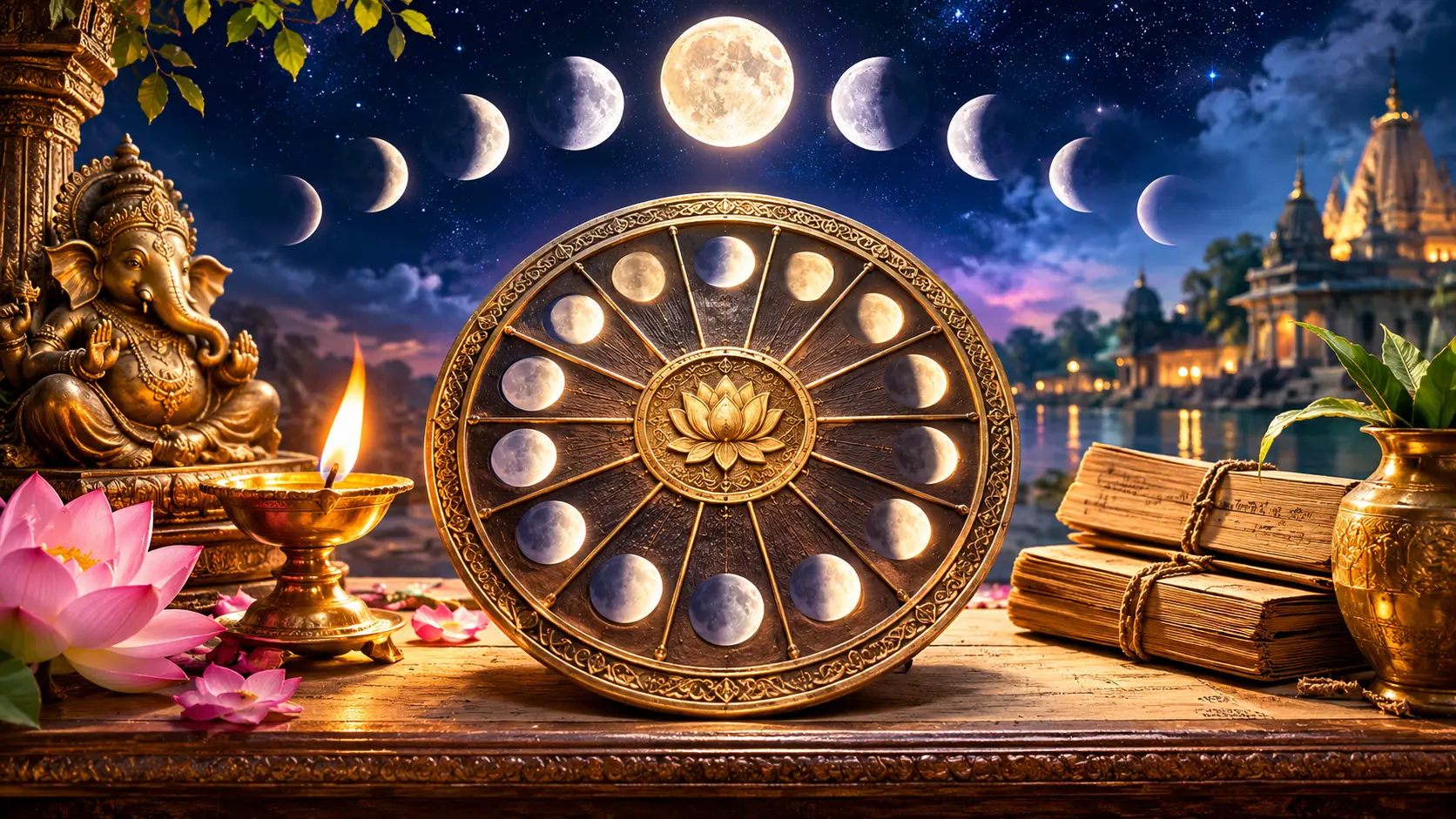
In traditional Hindu astrology and the Hindu lunar calendar, a tithi is a lunar day significant for religious observances, ceremonies, and other auspicious work. Each tithi has a presiding deity, a traditional classification, and specific indications of what kind of work is suitable.
The classic view is that the nature of the lunar day affects the results of anything done that day. Some tithis are thought to be good for marriage, ceremonies of all kinds, building, travel, etc. Others suit certain rituals and are traditionally not used for general celebrations.
The tithis are not classified only by their individual attributes. They are also classified by the lunar fortnight, the weekday on which they occur, and their traditional name as Nanda, Bhadra, Jaya, Rikta, or Purna.
This is the traditional system for picking out a favourable date (known as a muhurta in Hindu astrology).
What Is a Tithi?
A tithi is a lunar day in the traditional Hindu calendar. The lunar month is divided into two fortnights:
- Shukla Paksha: the Moon's waxing phase, beginning after Amavasya and continuing to Purnima.
- Krishna Paksha: the Moon's waning phase, running from after Purnima to Amavasya.
Each fortnight has fifteen tithis. The fifteenth tithi of the Shukla Paksha is Purnima (the Full Moon), and the fifteenth tithi of the Krishna Paksha is Amavasya (the New Moon).
Traditional astrological texts assign a god and a particular character to each tithi. Astrologers use these to determine appropriate activities, including religious, domestic, ceremonial, and other practical ones.
The presiding deity matters, as the deity's nature, qualities, and traditional functions are thought to reflect the tithi's character.
The Presiding Deities of the Fifteen Tithis
The traditional system associates the lunar days with the following deities:
| Tithi | Presiding Deity | Traditional Name |
| Pratipada (1st) | Agni | Nanda |
| Dwitiya (2nd) | Brahma | Bhadra |
| Tritiya (3rd) | Parvati/Gauri | Jaya |
| Chaturthi (4th) | Ganesha | Rikta |
| Panchami (5th) | Serpent deity | Purna |
| Shashthi (6th) | Kartikeya/Skanda | Nanda |
| Saptami (7th) | Surya | Bhadra |
| Ashtami (8th) | Shiva | Jaya |
| Navami (9th) | Durga | Rikta |
| Dashami (10th) | Yama | Purna |
| Ekadashi (11th) | Vishvadevas | Nanda |
| Dwadashi (12th) | Hari | Bhadra |
| Trayodashi (13th) | Kamadeva | Jaya |
| Chaturdashi (14th) | Shiva | Rikta |
| Purnima (15th) | Chandra | Purna |
Amavasya is linked with the Pitris (ancestral beings) and the Moon.
These associations traditionally determine each lunar day's character and which activities are appropriate.
Auspicious and Inauspicious Activities According to Tithi
The appropriateness of various activities varies from tithi to tithi. The traditional system specifies which rituals, domestic activities, religious observances and special acts are suitable and which are not.
Pratipada: The First Lunar Day
Pratipada is linked with Agni (the fire god).
According to the traditional text, Shukla Pratipada is generally unsuitable for several major auspicious ceremonies, including:
- Marriage
- Travel
- Sacred-thread ceremonies
- Religious consecration
- Simanta or prenatal ceremonial rites
- Chudakarana or the tonsure ceremony
- Construction of residences
- Housewarming ceremonies
Old scriptures make a very clear distinction between Shukla Pratipada and Krishna Pratipada. Certain things which are not done in the waxing fortnight may be done in the waning fortnight (though of course the discussion of the precise conditions of each would be separate).
This distinction matters, as a tithi's classification isn't necessarily the same in both fortnights.
Dwitiya: The Second Lunar Day
Dwitiya is linked with Brahma and the Bhadra classification.
Old scriptures see this tithi as very favourable for many ceremonies and practical purposes, especially those related to the king's affairs and all kinds of formalities.
Activities traditionally regarded as auspicious include:
- Sacred-thread ceremonies
- Religious consecration
- Marriage
- Travel
- Wearing ornaments
- Activities associated with royal or official responsibilities
Dwitiya is therefore linked with the successful performance of all manner of formal, ritual and socially significant activities.
Tritiya: The Third Lunar Day
Tritiya is linked with Parvati or Gauri and is of the Jaya type.
The favourable activities of Dwitiya are also considered suitable on Tritiya. Old scriptures go on to list several other activities as being auspicious:
- Travel and journeys
- Artistic and craft-related work
- Simanta ceremonies
- Chudakarana
- Annaprashana, the first feeding ceremony
- Housewarming ceremonies
The traditional classification of Tritiya includes ceremonial, artistic, and domestic activities.
Chaturthi: The Fourth Lunar Day
Chaturthi is linked with Ganesha and the Rikta.
Rikta tithis are traditionally considered unsuitable for general auspicious work. Old scriptures, however, list several specific activities considered acceptable on these days.
These include:
- Fire-related ritual actions
- Marana-related ritual activities
- Binding or restraint-related actions
- Specific ritual undertakings
- Activities involving weapons or instruments
- Poison-related ritual subjects
- Fire-related operations
- Metallurgical and metal-related work
Old scriptures distinguish these special activities from normal auspicious ceremonies, which are regarded as inauspicious on Rikta tithis.
Panchami: The Fifth Lunar Day
Panchami is linked to the Naga (serpent) god and the Purna.
Old scriptures say Panchami is a good day to complete all the auspicious work.
However, it has a specific restriction regarding repaying debt or lending money. You should not give money as a loan on this tithi, as that is traditionally associated with loss.
This point matters because Panchami is otherwise viewed as quite positive.
Shashthi: The Sixth Lunar Day
Shashthi is linked with Kartikeya (also known as Skanda).
Old scriptures say that most auspicious and nourishing activities are good on this tithi, with a few exceptions.
Activities traditionally regarded as favourable include:
- Nourishing and beneficial ceremonies
- Activities associated with warfare
- Artistic and craft-related work
- Architectural undertakings
- Ornaments and jewellery-related activities
- Clothing and textile-related work
The text explicitly rules out oil massage, the performance of ancestral rites and the use of a tooth-cleaning stick as part of the general category of good things.
This is the old way of looking at it, really, of judging each activity in isolation rather than saying that the entire tithi is good.
Saptami: The Seventh Lunar Day
Saptami is linked with Surya (the Sun god) and the Bhadra.
Old scriptures say the same activities considered good on Dwitiya, Tritiya, Panchami, and Shashthi are also successful on Saptami.
Saptami is traditionally considered a very favourable day for a wide variety of rituals, travel, artistic pursuits and all manner of good things.
Ashtami: The Eighth Lunar Day
Ashtami is linked to Shiva and the Jaya.
Old scriptures identify several activities as favourable on this tithi:
- Activities associated with warfare
- Architectural work
- Artistic and craft-related undertakings
- Royal or official affairs
- Writing
- Activities concerning women
- Gemstones and precious ornaments
The traditional classification of Ashtami therefore encompasses both the more specialist activities and those relating to craft, administration and ornamental items.
Navami: The Ninth Lunar Day
Navami is linked with Durga and the Rikta classification.
Like Chaturthi and Chaturdashi, Navami is also in the Rikta group.
Under the traditional model, the Rikta tithis are generally not used for any auspicious ceremony. They are associated with specific rituals and particular types of work.
Old scriptures list Navami as one of the Rikta tithis, which are not appropriate for any ordinary auspicious or festive activity.
Dashami: The Tenth Lunar Day
Dashami is linked with Yama and the Purna.
Old scriptures say that the same activities considered beneficial on Dwitiya, Tritiya, Panchami, and Saptami are also good on Dashami.
This includes all kinds of ceremonial, domestic, artistic, and practical activities.
Dashami is therefore traditionally regarded as a very good day for a wide variety of auspicious things.
Ekadashi: The Eleventh Lunar Day
Ekadashi is linked with the Vishvadevas and the Nanda classification.
Old scriptures focus on the observances and spiritual activities of this tithi.
Traditionally favourable undertakings include:
- Fasting and religious observances
- Worship and other religious duties
- Festivals dedicated to deities
- Architectural work
- Activities associated with warfare
- Artistic and craft-related work
Ekadashi is particularly noted for its connection with religious duties, fasting, and devotional observances.
Dwadashi: The Twelfth Lunar Day
Dwadashi is linked with Hari and the Bhadra.
Dwadashi is good for all activities involving movable and immovable property.
It also supports nourishing and beneficial activities, which are considered successful on this tithi.
Within the traditional framework, Dwadashi is seen as a fairly positive day for constructive and beneficial endeavours.
Trayodashi: The Thirteenth Lunar Day
Trayodashi is linked with Kamadeva and the Jaya classification.
Old scriptures say that the activities considered good on Dwitiya, Tritiya, Panchami, and Saptami are also good on Trayodashi.
This includes a wide range of ceremonies, practices, and activities done in the hope of a good outcome.
Chaturdashi: The Fourteenth Lunar Day
Chaturdashi is linked with Shiva and the Rikta.
As a Rikta tithi, Chaturdashi is traditionally regarded as being unsuitable for general auspicious work.
Old scriptures list it with Chaturthi and Navami, both linked to specific activities rather than general festive occasions.
Purnima: The Full Moon
Purnima is the full moon and is associated with Chandra (the Moon god) and the Purna category.
Old scriptures identify several favourable activities on Purnima:
- Yajna and sacrificial rituals
- Nourishing and beneficial ceremonies
- Mandala-related activities
- Activities associated with warfare
- Architectural work
- Marriage
- Artistic and craft-related undertakings
- Jewellery and ornamental activities
Purnima is traditionally considered a very good day for a great many ceremonies and constructive work.
Amavasya: The New Moon
Amavasya is the day associated with the Pitris (ancestors).
Old scriptures say the main thing done on Amavasya is the ancestral rites.
Some accounts also describe subsidiary ritual practices connected with the Shabara tradition.
Other auspicious, nourishing or festive ceremonies are traditionally avoided on Amavasya.
This classification highlights the New Moon day's specific ritual importance.
The Five Traditional Tithi Classifications
The 15 tithis are grouped into 5 groups of 3 tithis each. These are known as Nanda, Bhadra, Jaya, Rikta and Purna.
Each classification is linked to a particular traditional character.
| Classification | Tithis | Traditional Significance |
| Nanda | 1, 6, 11 | Associated with the Nanda category |
| Bhadra | 2, 7, 12 | Associated with the Bhadra category |
| Jaya | 3, 8, 13 | Associated with the Jaya category |
| Rikta | 4, 9, 14 | Traditionally unsuitable for general auspicious activities |
| Purna | 5, 10, 15 | Associated with the Purna category |
The names of these classifications traditionally correspond to their respective characteristics and outcomes.
Nanda Tithi
Nanda has Pratipada, Shashthi and Ekadashi.
The traditional framework associates these tithis with the Nanda classification. The day of the week and the lunar fortnight then determine their appropriateness for various activities.
Bhadra Tithi
Bhadra contains the 2nd, 7th and 12th.
Traditionally, these tithis are viewed in terms of their inherent characteristics and in relation to the weekday on which they occur.
Jaya Tithi
Jaya has Tritiya, Ashtami and Trayodashi.
The Jaya classification is classically linked to certain indications and results.
Rikta Tithi
Rikta has Chaturthi, Navami and Chaturdashi.
These three tithis are expressly stated to be unsuitable for normal auspicious ceremonies.
Old scriptures instead link Rikta tithis with certain specific kinds of activity (ritual and technical).
Purna Tithi
Purna comprises Panchami, Dashami and Purnima.
These tithis are traditionally described as Purna. Whether they suit a particular case depends on the nature of the activity and the wider astrological context.
Shukla Paksha and Krishna Paksha: Differences in Tithi Favorability
The traditional text also distinguishes between the two lunar fortnights.
According to its classification, the relative favourability of the tithis varies depending on whether the Moon is waxing or waning.
Tithi Classification During Shukla Paksha
Old scriptures divide Shukla Paksha into three sections:
| Lunar Section | Tithi Range | Traditional Classification |
| First section | Pratipada to Panchami | Inauspicious |
| Middle section | Panchami to Dashami | Auspicious |
| Final section | Dashami to Purnima | Auspicious |
Old scriptures explain that the first section is classified based on the Moon's waning state within its traditional framework.
The middle and final sections are the good ones.
Tithi Classification During Krishna Paksha
The final fortnight is a different ball game altogether.
| Lunar Section | Tithi Range | Traditional Classification |
| First section | Up to Panchami | Auspicious |
| Middle section | Panchami to Dashami | Moderate |
| Final section | Ekadashi to Amavasya | Inauspicious |
This shows that the traditional assessment of a tithi is not simply about what the tithi is in itself, but also where it falls in the fortnight.
Weekday and Tithi Combinations for Siddhi
Traditional texts identify certain weekday-tithi combinations as particularly auspicious.
These combinations are linked to the attainment of Siddhi (i.e. successful accomplishment).
| Weekday | Favorable Tithi Classification | Tithis |
| Friday | Nanda | 1, 6, 11 |
| Wednesday | Bhadra | 2, 7, 12 |
| Tuesday | Jaya | 3, 8, 13 |
| Saturday | Rikta | 4, 9, 14 |
| Thursday | Purna | 5, 10, 15 |
Under the traditional interpretation, these combinations remove certain astrological impediments and help see the venture through to completion.
Old scriptures make it clear that a Siddha tithi is traditionally regarded as one that overcomes all calendrical defects, including monthly directional restrictions and other named astrological considerations.
A properly constituted Siddha tithi can nullify the negative influences and facilitate the desired activity.
Weekday Combinations Considered Inauspicious
The old scriptures also list certain combinations of weekday and tithi that are traditionally considered inauspicious or destructive/unfavourable.
These are the Ghatakas (i.e. potentially harmful combinations) in the traditional system.
| Weekday | Tithi Classification | Tithis |
| Sunday | Nanda | 1, 6, 11 |
| Monday | Bhadra | 2, 7, 12 |
| Tuesday | Nanda | 1, 6, 11 |
| Wednesday | Jaya | 3, 8, 13 |
| Thursday | Rikta | 4, 9, 14 |
| Friday | Bhadra | 2, 7, 12 |
| Saturday | Purna | 5, 10, 15 |
These combinations are traditionally shunned when picking dates for auspicious occasions.
Old scriptures make it clear that you should consider the weekday along with the tithi, rather than looking at the lunar day alone.
Ghataka Nakshatras: Inauspicious Star and Weekday Combinations
In addition to tithi combinations, the text also identifies certain nakshatras regarded as inauspicious on particular days of the week.
A nakshatra is a lunar constellation, or stellar division, used in traditional Hindu astrology.
The following weekday and nakshatra combinations are identified in old scriptures:
| Weekday | Ghataka Nakshatra |
| Sunday | Bharani |
| Monday | Chitra |
| Tuesday | Uttara Ashadha |
| Wednesday | Dhanishtha |
| Thursday | Uttara Phalguni |
| Friday | Jyeshtha |
| Saturday | Revati |
Old scriptures say these nakshatras are inauspicious for any auspicious purpose when they fall on their respective weekdays.
The traditional muhurta system therefore considers the tithi, nakshatra, and weekday.
Complete Tithi Classification Table
The following table shows the tithi classifications as given in old scriptures.
| Tithi | Traditional Result | Presiding Deity | Classification | Shukla Paksha | Krishna Paksha |
| 1 | Siddhi | Agni | Nanda | Inauspicious | Auspicious |
| 2 | Accomplishment of work | Brahma | Bhadra | Inauspicious | Auspicious |
| 3 | Health | Gauri | Jaya | Inauspicious | Auspicious |
| 4 | Loss | Ganesha | Rikta | Inauspicious | Auspicious |
| 5 | Auspicious | Serpent deity | Purna | Inauspicious | Auspicious |
| 6 | Inauspicious | Skanda | Nanda | Moderate | Moderate |
| 7 | Auspicious | Surya | Bhadra | Moderate | Moderate |
| 8 | Disease | Shiva | Jaya | Moderate | Moderate |
| 9 | Death-giving | Durga | Rikta | Moderate | Moderate |
| 10 | Giver of wealth | Yama | Purna | Moderate | Moderate |
| 11 | Prosperity-related result | Vishvadevas | Nanda | Auspicious | Inauspicious |
| 12 | All accomplishments | Hari | Bhadra | Auspicious | Inauspicious |
| 13 | All accomplishments | Kamadeva | Jaya | Auspicious | Inauspicious |
| 14 | Unfavorable result | Shiva | Rikta | Auspicious | Inauspicious |
| 15 | Nourishment | Chandra | Purna | Auspicious | Inauspicious |
| 30 | Inauspicious | Pitris | — | — | — |
The traditional results in that table are simply the classifications as given in old scriptures. Interpret them in the context of the traditional system of astrology, not as a scientifically validated forecast.
How Tithi Selection Is Used in Traditional Muhurta Astrology
Tithi selection is a vital part of traditional Hindu muhurta astrology.
Choosing an auspicious tithi helps determine which lunar day best suits the task.
Astrologers assess different activities based on their nature.
For example:
- Marriage ceremonies are performed according to tithis traditionally considered most auspicious for domestic and ceremonial purposes.
- Religious observances and fasting are associated with tithis linked to devotional practices.
- Construction and architectural undertakings are evaluated using the relevant tithi classifications.
- Ancestral rites are traditionally associated with Amavasya.
- Specialised ritual activities may be assigned to tithis otherwise considered unsuitable for general auspicious ceremonies.
The traditional framework emphasises that a date's suitability depends on the activity.
A tithi unsuitable for one kind of ceremony may still suit another type of undertaking.
Frequently Asked Questions About Tithi Astrology
What does a tithi mean in Hindu astrology?
A tithi is a lunar day in the Hindu calendar. It is traditionally used to determine the timing of religious ceremonies, auspicious activities, and other undertakings according to the lunar cycle.
Which tithis are considered auspicious?
Old scriptures identify several tithis as favourable for different activities. Panchami, Dwitiya, Tritiya, Saptami, Dashami, Ekadashi, Dwadashi, Trayodashi, and Purnima are associated with various auspicious undertakings, subject to the specific conditions described in the traditional framework.
Which tithis are classified as Rikta?
Chaturthi, Navami, and Chaturdashi are classified as Rikta tithis.
These are traditionally considered unsuitable for ordinary auspicious ceremonies, although certain specialised activities are associated with them.
What are Nanda, Bhadra, Jaya, Rikta, and Purna tithis?
These are the five traditional tithi classifications.
- Nanda: 1, 6, 11
- Bhadra: 2, 7, 12
- Jaya: 3, 8, 13
- Rikta: 4, 9, 14
- Purna: 5, 10, 15
Each category is associated with particular traditional characteristics and indications.
Is Amavasya considered auspicious for ceremonies?
According to old scriptures, Amavasya is primarily associated with ancestral rites. People traditionally avoid other auspicious, nourishing, and celebratory activities on this day.
Why are weekdays important in tithi astrology?
The traditional system considers the relationship between the weekday and the tithi classification. Certain combinations are regarded as favourable for Siddhi, while others are considered Ghataka or inauspicious.
Are tithi predictions scientifically established?
Tithi-based interpretations belong to the traditional Hindu astrological and calendrical framework. They represent cultural beliefs about the timing of activities and should not be presented as scientifically established predictions.
Conclusion: The Traditional Significance of Tithi-Based Muhurta
The traditional classification of tithis provides a detailed system for understanding the relationship between lunar days, presiding deities, weekdays, and the suitability of different activities.
Each tithi carries its own traditional characteristics. Some are associated with marriage, domestic ceremonies, construction, religious observances, and other auspicious undertakings. Others are reserved for ancestral rites or specialised ritual activities.
The five classifications of Nanda, Bhadra, Jaya, Rikta, and Purna further organise the lunar days according to their traditional nature. The lunar fortnight, weekday, and nakshatra also help evaluate a particular date.
Within the traditional Hindu muhurta system, selecting an auspicious time therefore requires considering multiple calendrical factors together.
Understanding these classifications offers insight into the historical and cultural principles underlying traditional Hindu calendar practices and the selection of dates for religious and ceremonial activities.
0 Comments