

In classical Hindu traditional literature, the signs observed before undertaking a journey hold considerable significance. The direction of travel, objects encountered along the way, sounds heard, atmospheric conditions, and the traveller's mental disposition all matter to the journey's prospects.
The traditional understanding of travel omens (Shakuna Shastra) holds that some omens are auspicious and others inauspicious.
According to the traditional account preserved in the Matsya Mahapurana, certain objects, individuals, sounds, and natural phenomena are considered favourable or unfavourable when encountered at the beginning of a journey.
The text places particular emphasis on the circumstances surrounding departure. It also describes the importance of devotion, mental satisfaction, favourable winds, and auspicious indications in determining the traditional assessment of a journey.
This article explores the classical interpretation of auspicious and inauspicious travel omens, their traditional significance, and the principles associated with undertaking a journey under favourable circumstances.
What Are Travel Omens in Traditional Hindu Belief?
Travel omens are signs observed before or during a journey that are traditionally interpreted as indications of its possible outcome.
In classical Hindu traditions, these signs are not limited to a particular object or event. They may include:
- Objects encountered while leaving home.
- People seen along the route.
- Sounds heard at the time of departure.
- Movements of animals and birds.
- Atmospheric conditions and wind direction.
- Events involving vehicles, clothing, or travel equipment.
- The traveller's mental state and religious disposition.
The traditional framework considers these observations collectively rather than treating every sign as an isolated indication.
The Matsya Mahapurana describes both favourable and unfavourable signs, providing a detailed account of the circumstances regarded as beneficial or undesirable for a royal journey.
Inauspicious Omens Before a Journey
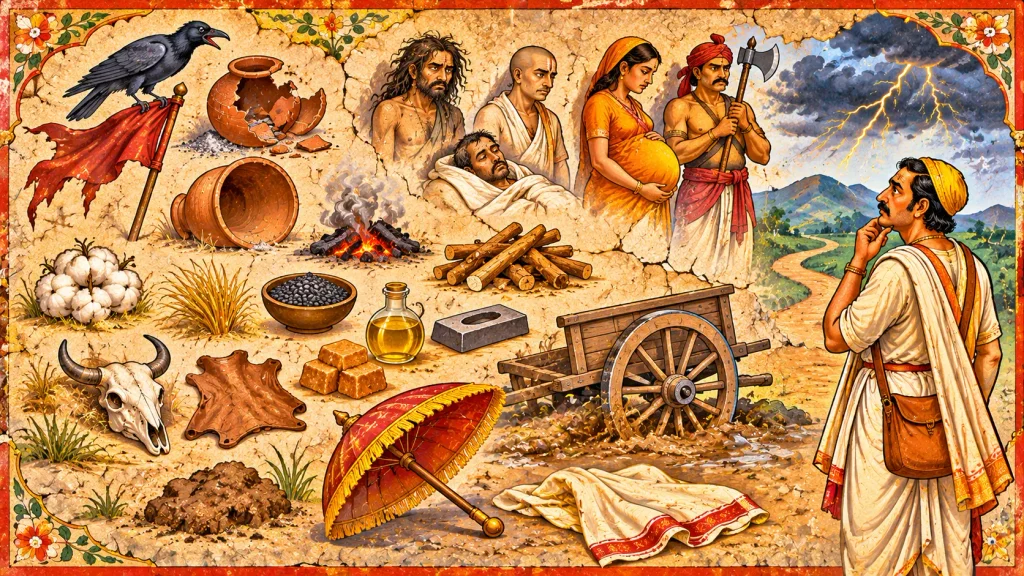
In classical interpretation, certain objects and circumstances encountered at the start of a journey are considered inauspicious.
These signs are traditionally associated with obstacles, danger, or an unfavourable journey.
1. Inauspicious Objects Encountered During Travel
The Matsya Mahapurana identifies several objects whose appearance before a journey is considered undesirable.
These include:
- Unsuitable medicinal plants.
- Black-coloured food.
- Cotton.
- Grass.
- Dried cow dung.
- Firewood.
- Burning charcoal or embers.
- Jaggery.
- Oil.
- Bran and husks.
- Ashes.
- Skulls and bones.
- Leather.
- Mud.
- Iron.
- Broken vessels.
- Empty vessels.
- Dead bodies.
- Horned animals.
The text also includes objects associated with insignificance, impurity, or undesirable conditions.
In this traditional framework, encountering such objects at departure is considered an unfavourable sign.
2. Inauspicious People Seen at the Beginning of a Journey
The classical account also identifies certain categories of individuals whose appearance before a journey is traditionally regarded as inauspicious.
These include:
- A person covered in oil.
- A person appearing dirty or unclean.
- A person who has shaved their head.
- A naked person.
- A person with loose or unbound hair.
- A sick person.
- A person wearing saffron-coloured garments.
- A person described as mentally disturbed.
- A destitute person.
- A eunuch.
- A pregnant woman.
- Executioners.
- Individuals the text describes as sinful.
- Certain groups classified through historical social terminology.
The Purana also mentions royal employees associated with imprisonment and punishment.
These classifications belong to the historical and cultural context. They should be understood as descriptions of traditional omen beliefs, not judgments about individuals' worth or character.
3. Unfavourable Sounds During Departure
Sounds are another important component of traditional travel omen interpretation.
The text considers the following unfavourable:
- Frightening musical sounds.
- Harsh sounds without proper rhythm.
- Certain discouraging statements made at departure.
The direction from which a statement is spoken is also significant.
According to the traditional interpretation:
- Hearing the word “Come” from the front is considered auspicious.
- Hearing the same word from behind is considered inauspicious.
- Hearing the word “Go” from behind is considered auspicious.
- Hearing the word “Go” from the front is considered inauspicious.
Discouraging statements suggesting that the traveller should stop, avoid proceeding, or question the journey's usefulness are described as unfavourable.
The traditional text associates such words with possible adversity.
4. Unfavourable Events Involving Flags, Vehicles, and Clothing
The classical account also identifies several physical occurrences that are considered undesirable during a journey.
These include:
- Carnivorous birds landing on flags or banners.
- A vehicle slipping.
- Clothing becoming caught or entangled.
- A traveller striking the head while passing through a doorway.
- An umbrella falling.
- A flag falling.
- Clothing or other travel-related items falling during departure.
These occurrences are traditionally interpreted as unfavourable indications.
The passage gives particular importance to events that happen while leaving the residence, suggesting that the moment of departure carries special significance within the traditional omen system.
What Should a King Do After Seeing an Inauspicious Omen?
The Matsya Mahapurana provides a specific response to unfavourable omens.
When a person first encounters an inauspicious sign, he should worship Lord Keshava, the slayer of Madhu, through devotional hymns.
The traditional instruction may be summarised as follows:
| First appearance of an inauspicious omen | Worship Lord Keshava through hymns intended to remove inauspiciousness |
| Second appearance of an inauspicious omen | Return to the residence |
It demonstrates that the traditional approach does not merely catalogue omens but also prescribes a religious response to unfavorable signs.
Auspicious Omens Before a Journey
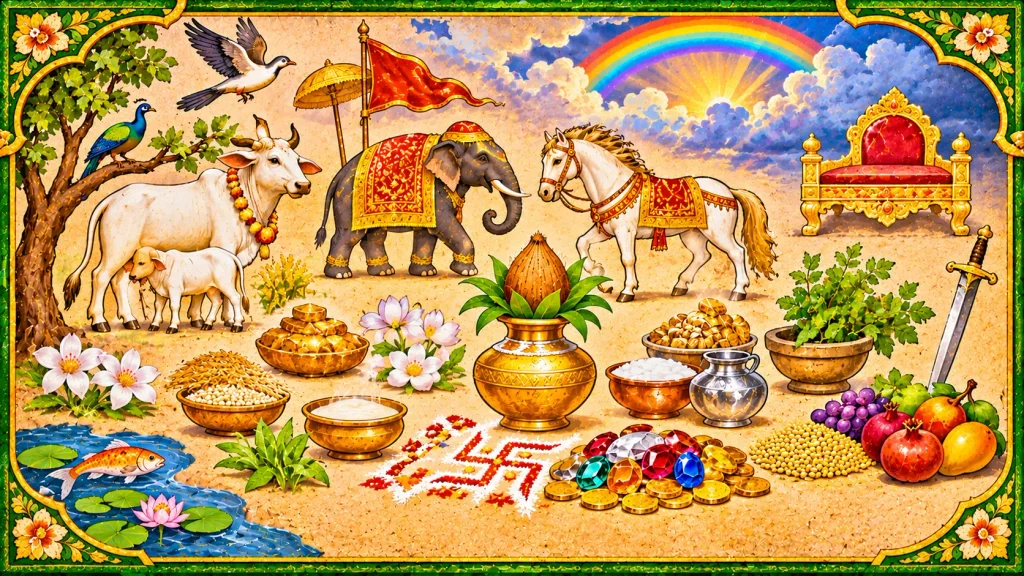
The classical text provides an extensive list of signs regarded as auspicious before a journey.
These signs are traditionally associated with favourable circumstances, success, and victory.
1. Auspicious Objects Seen Before Departure
The following objects are identified as favourable travel omens:
- White flowers.
- A full water pot.
- Aquatic creatures.
- Birds.
- Meat.
- Fish.
- Cows.
- Horses.
- Elephants.
- A single tethered animal.
- Goats.
- Gold.
- Silver.
- Copper.
- Precious gems.
- Medicinal plants.
- Barley.
- Yellow mustard seeds.
- Wet cow dung.
- Clay.
- Ghee.
- Curd.
- Milk.
- Various fruits.
The text also mentions a dead body that is not accompanied by crying or lamentation.
These objects and circumstances are considered auspicious within the traditional interpretation of travel omens.
2. Auspicious People and Religious Signs
The Matsya Mahapurana also identifies certain people and religious circumstances as favourable.
These include:
- Deities.
- Friends.
- Brahmins.
- A prostitute.
- A person or vehicle carrying human passengers.
- A beautiful throne.
- A sword.
- An umbrella.
- A flag.
- Weapons.
- Royal insignia.
The text also includes various sacred and auspicious symbols, such as:
- Swastika.
- Vardhamana.
- Nandyavarta.
- Kaustubha jewel.
These symbols are traditionally associated with auspiciousness and favourable indications.
3. Auspicious Sounds and Musical Notes
The sounds heard before or during a journey also influence its traditional interpretation.
The following are considered favourable:
- Pleasant musical sounds.
- Melodious sounds.
- Deep and resonant musical tones.
- The musical notes Gandhara.
- Shadja.
- Rishabha.
- Other favourable musical notes.
In contrast to frightening or irregular sounds, harmonious and pleasing sounds are traditionally regarded as beneficial.
The distinction between favourable and unfavourable sounds reflects the importance of harmony and proper rhythm in the classical omen framework.
Wind Direction and Weather as Travel Omens
Natural atmospheric conditions are also described in the traditional interpretation of travel signs.
1. Unfavourable Wind
According to the passage, a dry wind carrying sand particles that touches the earth while blowing from an unfavourable direction is considered frightening.
The text identifies this type of wind as an indication of potential danger.
2. Favourable Wind
A wind blowing from a favourable direction is regarded as beneficial when it possesses the following characteristics:
- Gentle.
- Cool.
- Pleasant to the touch.
Such a breeze is traditionally associated with comfort and happiness during the journey.
The distinction between favourable and unfavourable winds is based on both their direction and their physical characteristics.
3. Clouds and Thunderous Sounds
The passage describes dense, smooth-textured clouds producing deep sounds resembling the roaring of elephants as auspicious.
These clouds are traditionally interpreted as favourable signs.
The text also considers the following auspicious:
- Lightning that shines behind the traveller.
- The appearance of a rainbow.
These atmospheric phenomena are included among the positive indications associated with a journey.
4. Inauspicious Solar and Lunar Conditions
The Matsya Mahapurana identifies certain celestial conditions as unfavourable.
These include:
- The appearance of the solar disc.
- The appearance of the lunar disc.
- Heavy and intense rainfall.
Within the traditional framework, these conditions are considered undesirable during a journey.
The passage does not provide additional numerical predictions or specific future events associated with these signs.
5. Favourable Planetary Positions
Planets rising in favourable directions are regarded as auspicious.
Among them, Jupiter is particularly emphasised as a favourable indicator.
This reflects the importance of celestial observations within traditional Hindu interpretations of journeys and royal undertakings.
The Importance of Faith, Devotion, and Mental Satisfaction
One of the passage's most significant aspects is its emphasis on the traveller's internal disposition.
The Matsya Mahapurana identifies several qualities that are considered favourable during a journey:
- Faith in religious principles.
- Devotion.
- Respect for revered persons.
- A cheerful and contented mind.
These qualities are described as praiseworthy in the context of travel.
Mental Satisfaction as a Sign of Victory
The text gives particular importance to mental satisfaction.
According to the traditional passage, a contented mind is the supreme indication of victory during a journey.
It further suggests that the traveller's inner satisfaction should be regarded as comparable to all auspicious omens combined.
This is an important feature of the classical interpretation.
The passage does not restrict favourable indications to external objects, celestial observations, or environmental conditions. It also emphasises the mental and devotional state of the person undertaking the journey.
Why Mental Contentment Is Emphasised
Within the traditional understanding, a journey accompanied by faith, devotion, respect, and inner satisfaction is regarded as especially favourable.
The text therefore places mental contentment at the centre of its description of auspicious travel conditions.
Rather than treating it as an ordinary emotional state, the passage presents it as a significant indication of victory.
Signs Traditionally Associated With Victory During a Journey
The classical passage identifies several indications consistently considered favourable for success.
These include:
- Vehicles displaying eagerness or readiness.
- An abundance of joy in the traveller's mind.
- The appearance of auspicious omens.
- Reports or announcements associated with victory.
- The availability of auspicious objects.
- Hearing favourable or मंगलकारी sounds.
The text describes these indications as regularly associated with victory.
The traditional interpretation therefore considers the journey's surrounding circumstances as a combination of external and internal signs.
The presence of favourable objects, positive reports, suitable travel conditions, and mental satisfaction is regarded as particularly beneficial.
Difference Between Auspicious and Inauspicious Travel Omens
The following table provides a concise overview of the classical distinctions described in the passage.
| Objects | White flowers, gold, silver, gems, full water pot | Ashes, bones, skulls, broken vessels |
| People | Friends, Brahmins, deities | Certain historically classified individuals |
| Sounds | Pleasant, melodious, deep musical sounds | Frightening, harsh, irregular sounds |
| Wind | Gentle, cool, favourable-direction wind | Dry, sand-bearing wind from an unfavourable direction |
| Clouds | Dense clouds with deep, elephant-like sounds | Unfavourable solar and lunar appearances |
| Weather | Rainbow and favourable lightning | Heavy rainfall |
| Vehicles | Vehicles showing readiness | Vehicles slipping |
| Departure events | Favourable objects and signs | Head injury, falling umbrella, flag, or clothing |
| Mental state | Faith, devotion, respect, contentment | Discouraging speech and unfavourable indications |
This comparison summarises the traditional interpretation and does not present the omens as scientifically established predictors.
Frequently Asked Questions About Travel Omens in Hindu Tradition
What are auspicious omens before a journey according to the Matsya Mahapurana?
The Matsya Mahapurana describes white flowers, a full water pot, cows, horses, elephants, gold, silver, precious gems, barley, yellow mustard, sacred symbols, pleasant musical sounds, favourable winds, rainbows, and certain planetary positions as auspicious travel indications.
Which objects are considered inauspicious before travelling?
The passage identifies ashes, skulls, bones, broken vessels, empty vessels, dead bodies, charcoal, firewood, oil, cotton, grass, and certain other objects as unfavourable signs when encountered before a journey.
Is seeing a cow considered auspicious before a journey?
Yes. According to the traditional interpretation in the Matsya Mahapurana, seeing a cow before a journey is considered auspicious.
Is a full water pot an auspicious travel omen?
Yes. The classical passage explicitly includes a full water pot as an auspicious sign.
What does the traditional text say about wind direction during travel?
The passage considers a gentle, cool, pleasant wind blowing from a favourable direction beneficial. A dry wind carrying sand particles from an unfavourable direction is described as frightening.
What should a king do after seeing an inauspicious omen?
The text instructs a king to worship Lord Keshava through hymns when an inauspicious omen appears for the first time. If the omen appears again, the king should return to his residence.
Is mental satisfaction considered auspicious during a journey?
Yes. The passage identifies mental satisfaction as the supreme indication of victory during a journey. It also emphasises faith, devotion, respect for revered persons, and a cheerful mind.
Are traditional travel omens scientifically proven?
The signs described in the Matsya Mahapurana belong to a traditional religious and cultural system of interpretation. They should not be understood as scientifically verified methods for predicting travel outcomes.
The Traditional Understanding of Favourable Journeys
The classical interpretation of travel omens in the Matsya Mahapurana provides a comprehensive set of guidelines on auspicious and inauspicious signs before a journey.
The passage includes a wide range of signs, from objects and people encountered during departure to sounds, winds, clouds, celestial conditions, and the traveller's mental disposition.
While certain objects and circumstances are traditionally considered unfavourable, others are associated with happiness, success, and victory.
The text also emphasises religious devotion and mental contentment, presenting a satisfied mind as the supreme indication of victory.
Within this traditional framework, the significance of a journey is understood by considering external signs, environmental circumstances, religious observance, and inner disposition.
These interpretations remain part of the historical and cultural heritage of classical Hindu literature and provide insight into the traditional understanding of journeys and auspicious beginnings.
Reference: Matsya Mahapurana
0 Comments