
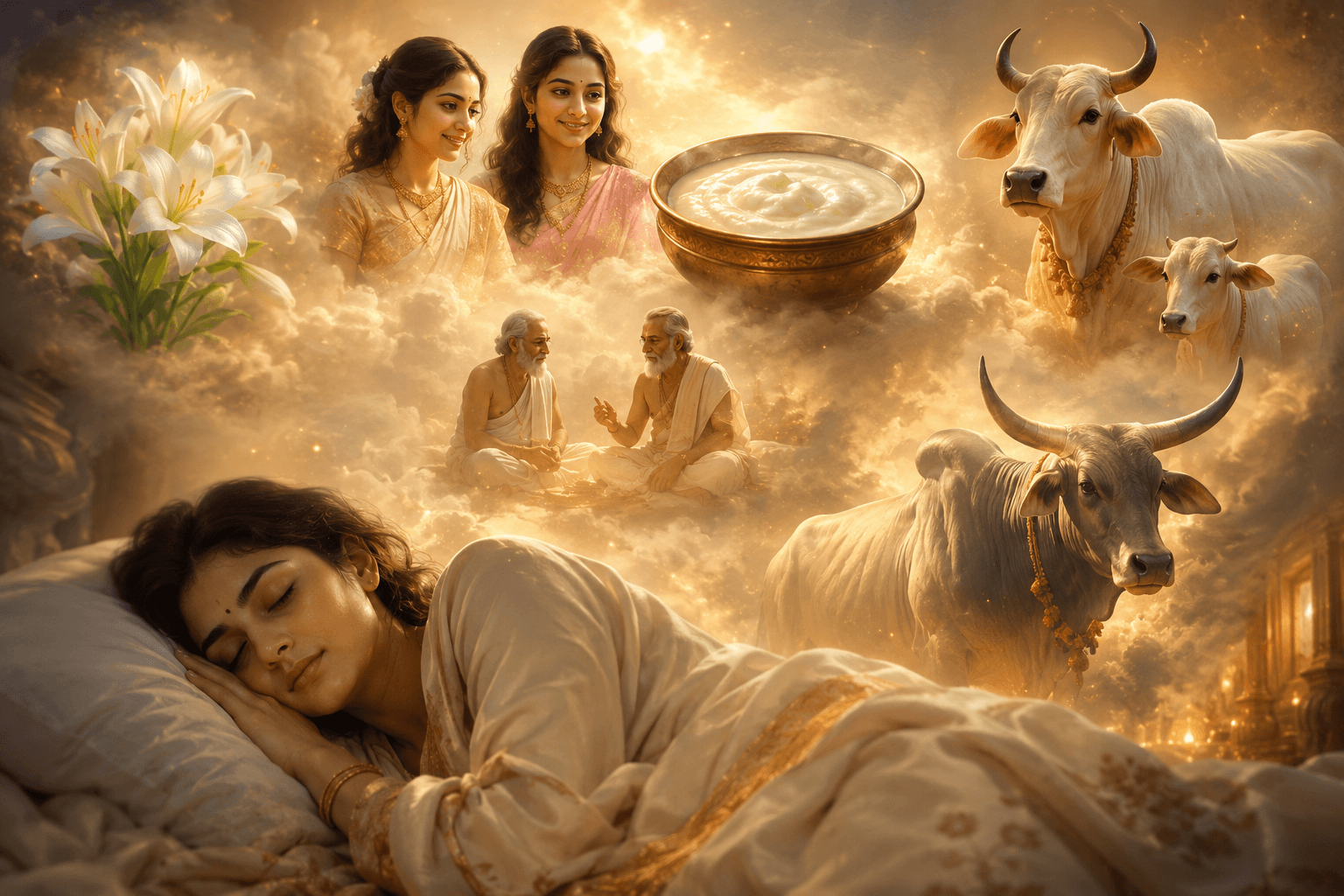
Dreams have long occupied an unusual place in the intellectual and ritual traditions of India. They were not always treated simply as private images produced during sleep. In classical literature, certain dreams were examined as omens—visions believed to carry indications about what might follow in waking life.
Among the many dream signs preserved in the Atharvavedic tradition is a particularly striking group of auspicious visions. A short passage identifies six things whose appearance in a dream is associated with the receipt of wealth: white flowers, maidens, curd, cows, Brahmins, and bulls.
The statement is remarkably direct. It does not present these images merely as vague symbols of abundance, nor does it offer a modern psychological explanation. It assigns them a traditional result: the dreamer receives wealth.
That distinction matters.
A contemporary reader may naturally ask what such images “represent” emotionally or psychologically. But the classical dream-omen framework works differently. Its primary concern is often the relationship between a particular dream image and a particular anticipated result. The meaning is therefore not something to be freely reinvented. It belongs to a traditional system in which certain visions are considered auspicious and others unfavorable.
This article examines the six signs individually while preserving the central prediction given in the source.
The Classical Idea of an Auspicious Dream
The dream tradition associated with the Atharvavedic Pariśiṣṭas is broader than a simple catalog of lucky and unlucky images. The material discusses dreams as omens and, elsewhere, gives attention to circumstances such as the time of night in which a dream occurs. A study of the Pariśiṣṭas records a traditional scheme in which dreams seen at different times of night were believed to bear fruit at different times, with those seen around sunrise regarded as producing their result immediately.
That wider context is important when reading any individual dream prediction.
The six signs discussed here should first be understood in light of the explicit statement preserved in the supplied source. Their common traditional outcome is the receipt of wealth. The source does not provide a separate monetary amount, a fixed number of days, or a detailed condition for each of the six.
Therefore, this interpretation should not be expanded into promises about a particular salary, inheritance, business success, lottery result, or exact financial gain. Such additions would go beyond the evidence.
The strength of the initial passage lies precisely in its simplicity.
1. Dreaming of White Flowers
Among the six auspicious signs, white flowers occupy a visually distinctive place.
In a dream, seeing white flowers, according to the supplied classical passage, is associated with receiving wealth.
The interpretation is favorable and direct. There is no indication in the supplied passage that the dreamer must perform a particular action, encounter the flowers in a particular location, or see a particular number of flowers for the prediction to apply.
What Does Seeing White Flowers in a Dream Mean?
The traditional answer is succinct:
Seeing white flowers in a dream is an auspicious sign associated with receiving wealth.
The source does not ask the reader to reinterpret the flowers as a metaphor for self-growth, emotional healing, subconscious desire, or psychological development. Those approaches belong to different interpretive systems.
Here, the relevant framework is traditional dream omen interpretation.
The whiteness of the flowers is also part of the actual dream description and should not be casually removed. The omen is not simply “seeing flowers.” It is specifically seeing white flowers.
That distinction is important for faithful interpretation.
The Traditional Prediction
The prediction can be stated without decoration:
- Dream symbol: White flowers
- Standard classification: Auspicious
- Traditional prediction: The dreamer receives wealth
No numerical prediction is attached to this sign in the supplied passage.
2. Dreaming of Maidens
The second dream sign is the appearance of maidens.
According to the same classical passage, seeing maidens in a dream is associated with receiving wealth.
This is another example of how classical dream literature can attach a concrete outcome to an otherwise ordinary dream image.
What Does Seeing Maidens in a Dream Mean?
Within the tradition represented by the supplied source, the interpretation is favorable:
Seeing maidens in a dream is traditionally regarded as a sign that the dreamer will receive wealth.
It is worth resisting the temptation to impose a contemporary interpretation on the image. The source does not state that the dream signifies romance, marriage, youth, beauty, attraction, fertility, or emotional fulfillment.
Those meanings may appear in other interpretive traditions, but they are not the prediction supplied here.
The classical statement is narrower and more precise.
The Traditional Prediction
- Dream symbol: Maidens
- Standard classification: Auspicious
- Traditional prediction: The dreamer receives wealth
This renders the dream a favorable sign within the particular tradition represented by the passage.
3. Dreaming of Curd
The third sign is curd, a familiar food that receives a specific place in the classical dream-omen passage.
The source states that seeing curd in a dream is associated with receiving wealth.
This is an important example of why classical dream interpretation should be read carefully rather than hastily generalized.
The source does not say “food represents prosperity” in an open-ended way. Instead, it identifies curd as one of the particular dream visions associated with the stated result.
What Does Seeing Curd in a Dream Mean?
According to the supplied traditional material:
Seeing curd in a dream is an auspicious sign associated with receiving wealth.
Nothing in the source indicates that the curd must be eaten, touched, offered, spilled, fresh, sour, or placed in a particular vessel. Those details should not be invented.
The safest interpretation is therefore also the most faithful one: the dream image itself is listed as a favorable omen of wealth.
The Traditional Prediction
- Dream symbol: Curd
- Standard classification: Auspicious
- Traditional prediction: The dreamer receives wealth
The prediction is positive, but the source does not specify the amount or form of that wealth.
4. Dreaming of Cows
Among the six signs, cows stand out because they hold a particularly important place within the wider ritual and cultural world surrounding Vedic literature.
A study of the Atharvavedic Pariśiṣṭas notes the important role attributed to cows in the collection's cultural material, including their presence among auspicious objects and their connection to ritual beliefs.
But for the particular dream under discussion, the supplied source gives a specific prediction: seeing cows in a dream indicates that the dreamer will receive wealth.
What Does Seeing a Cow in a Dream Mean?
Within this classical dream-omen framework:
Seeing cows in a dream is a favorable sign associated with receiving wealth.
The plural form matters because the source specifically lists cows. A faithful article should therefore avoid casually changing the dream into a generic discussion of “cow symbolism.”
The interpretation is also not a prediction about livestock ownership or agricultural prosperity specifically. The source gives the wider result of receiving wealth.
The Traditional Prediction
- Dream symbol: Cows
- Established classification: Auspicious
- Traditional prediction: The dreamer receives wealth
The wider cultural significance of cows can provide historical background, but it should not replace explicit dream prediction.
5. Dreaming of Brahmins
The fifth sign is the appearance of Brahmins.
The supplied passage includes Brahmins among the six visions traditionally associated with receiving wealth.
This dream is especially important to interpret using the source's terminology rather than substituting a modern equivalent. The word “Brahmins” should remain distinct from generic terms such as “priests” or “religious people,” because those expressions can imply a different degree of specificity.
What Does Seeing Brahmins in a Dream Mean?
The traditional prediction is:
Seeing Brahmins in a dream is an auspicious sign associated with receiving wealth.
The supplied source does not specify whether the Brahmins are speaking, blessing the dreamer, performing a ritual, traveling, teaching, or simply appearing. Those distinctions therefore should not be invented as separate predictions.
The dream symbol should remain exactly within the scope supported by the source.
The Traditional Prediction
- Dream symbol: Brahmins
- Standard classification: Auspicious
- Traditional prediction: The dreamer receives wealth
This is a direct traditional omen, not a scientific forecast. The distinction is essential when presenting classical dream interpretation to a modern audience.
6. Dreaming of Bulls
The sixth and final sign in the passage is the appearance of bulls.
The source places bulls alongside the other five auspicious dream visions and associates their appearance with the receipt of wealth.
The wider Pariśiṣṭa tradition also contains other dream references involving bulls. A scholarly study of material records, for example, notes that dreaming of mounting certain objects—including a bull—can be associated with prosperity in other dream contexts.
That broader material should not, however, be confused with the specific passage examined here.
What Does Seeing Bulls in a Dream Mean?
For the particular dream sign in the supplied source:
Seeing bulls in a dream is traditionally regarded as an auspicious sign associated with receiving wealth.
No further condition is given in the passage.
It does not say that the bull must be white, moving, standing, charging, grazing, or being ridden. Those details belong to other possible dream formulations and should not be imported into this one.
The Traditional Prediction
- Dream symbol: Bulls
- Standard classification: Auspicious
- Traditional prediction: The dreamer receives wealth
The interpretation remains deliberately focused on the stated omen.
What These Six Dreams Have in Common
Although the six images are quite different—flowers, people, food, cattle, religious figures, and animals—the classical passage gives them a common outcome.
| Dream vision | Traditional interpretation |
| White flowers | Receiving wealth |
| Maidens | Receiving wealth |
| Curd | Receiving wealth |
| Cows | Receiving wealth |
| Brahmins | Receiving wealth |
| Bulls | Receiving wealth |
The repetition is significant.
The source does not construct six entirely different financial predictions. Instead, it groups these six dream visions under a single favorable outcome: wealth comes to the dreamer.
That makes the passage less like a modern dream dictionary and more like a compact catalog of traditional omens.
Why the Exact Dream Image Matters
One of the most important lessons in reading classical dream interpretation is that precision matters.
A dream of white flowers is not automatically equivalent to a dream of flowers of any color.
A dream of cows is not necessarily identical to every possible dream involving cattle.
A dream of bulls should not automatically be merged with a dream of riding a bull, because other passages may attach different outcomes to different actions or circumstances.
This principle is particularly important in traditional texts, where a seemingly small alteration can change the interpretation.
The wider-ranging Vedic dream material demonstrates this sensitivity to circumstance. Different dream actions and objects can yield different results, and the timing of the dream may also be relevant.
For that reason, the six signs discussed here should be preserved exactly as they appear in the supplied passage.
Does the Dream Guarantee Wealth?
A responsible presentation needs to distinguish traditional belief from fact.
The classical passage predicts that the dreamer will receive wealth. That is the traditional interpretation and should be stated clearly rather than weakened into an unrelated broad statement about “abundance.”
At the same time, this is a traditional omen system, not a scientifically established method for predicting financial events.
Therefore, the most accurate editorial formulation is:
According to the classical dream tradition as represented in the source, these six visions are auspicious signs of receiving wealth.
That preserves the strength of the original prediction without presenting an ancient belief as a scientifically verified financial forecast.
Dream Timing and the Wider Atharvavedic Tradition
There is another reason readers should avoid treating dream interpretation as a collection of isolated one-line predictions. The wider dream material associated with the Atharvavedic Pariśiṣṭas stresses the timing of dreams. One scholarly account records a traditional sequence in which dreams seen in the first watch of the night were believed to bear fruit within a year, those in the second watch within eight months, those in the third within four months, dreams seen when cows were about to be released within a month, and dreams occurring at sunrise immediately.
These timing rules belong to the wider dream tradition and should not be falsely presented as a special timing rule for the six wealth-producing dreams in the supplied passage.
That distinction is vital. The source for this article states what the six signs predict, but it does not assign a specific numerical frame to each.
Accordingly, no exact number of days, months, or years should be invented for white flowers, maidens, curd, cows, Brahmins, or bulls.
A Traditional Reading, Not a Modern Psychological Diagnosis
Modern readers may approach dreams through psychology, neuroscience, memory, stress, emotions, or everyday experience. Those approaches ask different questions from classical omen literature.
A traditional dream interpretation asks:
What outcome does this particular dream sign indicate within the inherited interpretive system?
For the six signs considered here, the answer supplied by the classical material is unusually clear: receiving wealth.
There is therefore no need to introduce speculative explanations about the subconscious mind, hidden desires, manifestation, the law of attraction, or modern energy theories. None of those concepts is required to understand the prediction preserved in the source.
Keeping the two approaches separate actually makes the article stronger. Readers can appreciate the historical and cultural relevance of the dream tradition without confusing it alongside contemporary explanations of dreaming.
The Meaning of Wealth in the Prediction
The word wealth should also be handled carefully.
The supplied passage says that the dreamer receives wealth. It does not specify whether this refers to money, property, cattle, valuables, inheritance, business income, gifts, or other forms of material gain.
For that reason, the article should not manufacture a specific financial scenario.
The most faithful interpretation is:
The dream is traditionally regarded as an omen of receiving wealth.
That wording preserves the prediction while observing the source's limits.
Six Auspicious Dream Signs at a Glance
The entire teaching can be reduced to six memorable signs:
White Flowers
A dream of white flowers is traditionally associated with receiving wealth.
Maidens
Seeing maidens in a dream is traditionally associated with receiving wealth.
Curd
Seeing curd in a dream is traditionally associated with receiving wealth.
Cows
Seeing cows in a dream is traditionally associated with receiving wealth.
Brahmins
Seeing Brahmins in a dream is traditionally associated with receiving wealth.
Bulls
Seeing bulls in a dream is traditionally associated with receiving wealth.
The common thread is unmistakable: all six are presented as favorable signs with the same stated material outcome.
A Note on Reading Classical Dream Omens Responsibly
Ancient dream literature deserves neither sensationalism nor dismissal.
If treated as a fortune-telling guarantee, a short classical passage can easily be exaggerated into claims that it never made. Conversely, if its traditional framework is stripped away completely, its historical meaning is lost.
A more responsible reading occupies the middle ground.
The text can be understood on its own terms: it preserves a traditional belief that certain dreams serve as auspicious omens and that certain visions indicate specific outcomes.
For the six signs discussed here, the result is wealth.
The passage does not provide a detailed financial roadmap. It does not promise a specific amount. It does not identify the source of the wealth. It does not state that every dreamer will experience the prediction in the same way.
Those boundaries are part of a correct interpretation.
Frequently Asked Questions
What does it mean to dream of white flowers?
According to the supplied classical dream tradition, seeing white flowers in a dream is associated with receiving wealth.
What does it mean to dream of maidens?
The traditional interpretation in the supplied passage associates seeing maidens in a dream with receiving wealth.
What does seeing curd in a dream mean?
The source identifies curd as one of the dream signs associated with receiving wealth.
Is seeing cows in a dream considered auspicious?
Yes. In the supplied passage, seeing cows is presented as an auspicious dream sign associated with receiving wealth.
What does seeing Brahmins in a dream indicate?
The classical interpretation states that seeing Brahmins in a dream signifies receiving wealth.
What does dreaming of bulls mean?
According to the supplied passage, seeing bulls in a dream is associated with receiving wealth.
Do these dreams predict a specific amount of money?
No specific amount is provided in the supplied passage. The traditional prediction is simply receiving wealth.
Is this a scientific prediction of financial gain?
No. It is a traditional dream-omen interpretation preserved in classical literature, not a scientifically established method of predicting financial events.
Conclusion: Six Dreams, One Auspicious Prediction
The six dream signs preserved in the supplied passage form a small but striking catalog of auspicious omens: white flowers, maidens, curd, cows, Brahmins, and bulls.
Their imagery is diverse, but their traditional prediction is the same.
The dreamer who sees these signs is said to receive wealth.
The significance of the passage does not lie in converting every dream into a modern prediction, precisely preserving the tradition's interpretive logic. Each symbol should remain distinct, its qualifying details should not be casually changed, and the explicit prediction should not be weakened or replaced with a vague statement about prosperity.
At the same time, classical interpretation should be presented honestly as traditional knowledge rather than scientific fact.
Read in that spirit, these six dreams give a fascinating insight into an older way of understanding the boundary between sleep, omen, and waking life. A white flower, a maiden, a bowl of curd, a cow, a Brahmin, or a bull appearing in the world of dreams may be read not simply as an image passing through the night, but as a favorable sign pointing toward the arrival of wealth.
That is the prediction the tradition preserves—and that is where its interpretation should remain.
Reference: The Pariśiṣṭas of the Atharvaveda
0 Comments