
Dreams have long occupied a distinctive place in Indian traditions of interpretation. They were not always treated merely as private images arising during sleep. In classical dream lore, particular objects, actions, places, people, and circumstances could be regarded as meaningful signs, with their interpretation depending closely on what was actually witnessed in the dream.
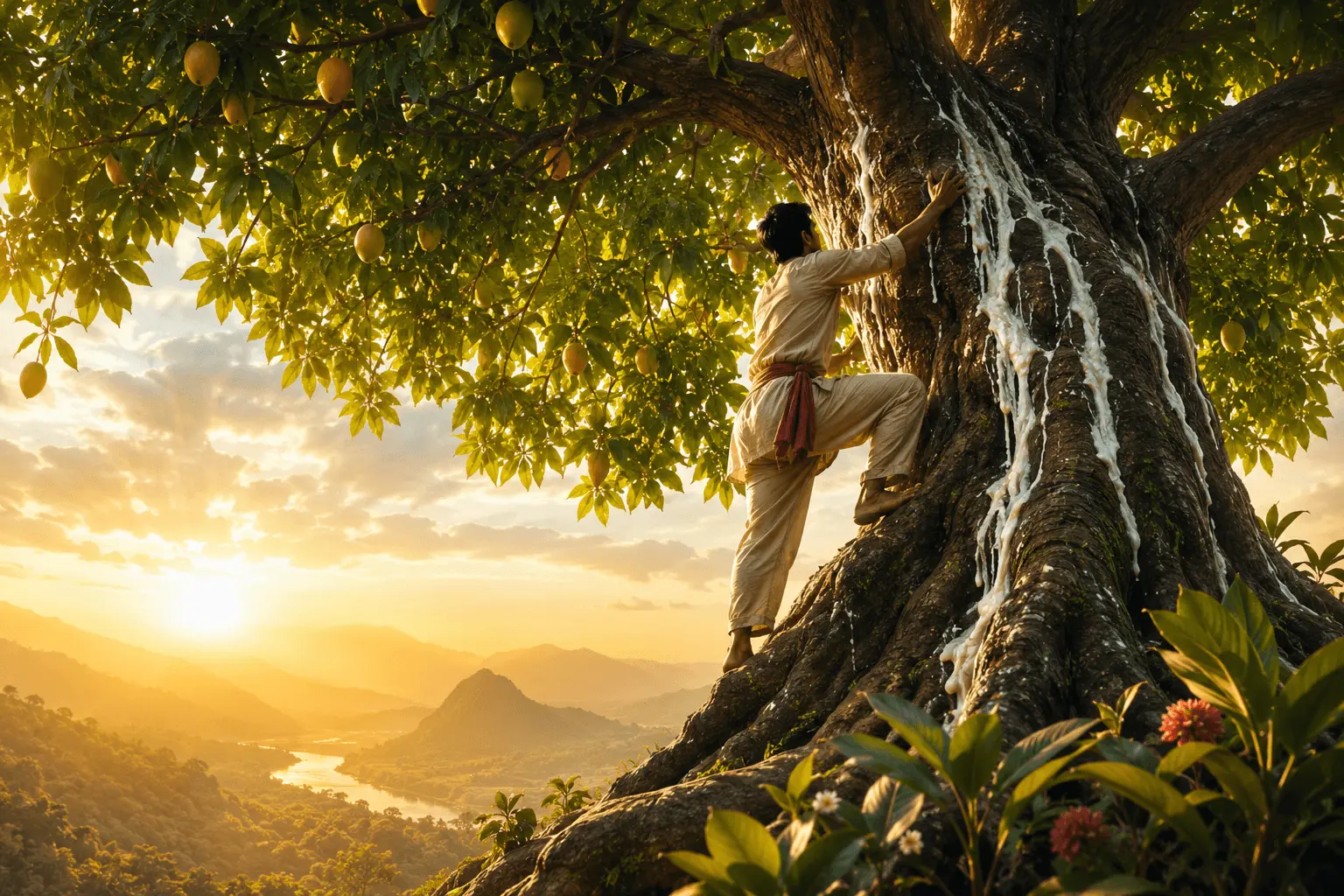
Among these traditional signs is a striking image: seeing and climbing a tree that yields milk-like sap or a tree that bears fruit.
The interpretation preserved in the supplied traditional material is direct. Such a dream is understood in the context of acquiring wealth. The important point is that the dream does not simply involve seeing an ordinary tree. The source specifically preserves the qualities of the tree—its milky or sap-bearing nature, or its fruit-bearing character—and also preserves the action of climbing it. Those details therefore belong to the complete dream symbol and should not be casually separated from the interpretation.
This makes the dream especially interesting from the perspective of classical Indian dream interpretation. The image combines a living, productive tree with upward movement, connecting the complete experience to material acquisition.
Rather than reducing the dream to a modern psychological prediction, the traditional reading should be kept within its own framework: the dream is regarded as an auspicious sign of wealth.
Vedic & Adhyatmik Interpretation
According to the classical interpretation provided, seeing and climbing a milky or fruit-bearing tree in a dream signifies the acquisition of wealth.
That is the central prediction and should remain the foundation of the interpretation.
The source does not provide a long chain of additional conditions or a separate catalog of outcomes for this particular dream. It presents the essential image and its result: a person dreams of seeing and climbing such a tree, and the dream is understood to relate to acquiring wealth.
This directness matters.
Dream interpretation can easily become distorted when a short traditional statement is expanded into a collection of modern claims. In this case, there is no need to do so. The classical significance is already clear enough to stand on its own.
Why the Tree Matters
The tree is not described merely as a tree. Its productive qualities are part of the dream description.
The source distinguishes trees associated with milk or sap and trees associated with fruit. Both belong to the same traditional omen in the supplied passage. The tree therefore appears as something that yields value.
At the same time, the dreamer does not merely observe the tree from a distance. The dream includes the action of climbing it.
The complete image is consequently:
- Seeing the tree
- Encountering its productive or yielding quality
- Climbing the tree
- Receiving the traditional association with acquisition of wealth
These details should remain together when interpreting the dream.
The Traditional Prediction
The prediction can be stated plainly:
Dreaming of seeing and climbing a milky or fruit-bearing tree is traditionally understood as a sign of wealth acquisition.
The source does not specify a particular amount of wealth, a precise financial instrument, or a fixed date by which the acquisition will occur. Those details should therefore not be invented.
Likewise, the interpretation should not be changed into a vague statement that the dream merely “symbolizes abundance.” The supplied text gives a more specific traditional result: acquisition of wealth.
Cultural & Historical Symbolism
1. Spiritual Understanding
Within the traditional framework, a productive tree presents an image of something capable of yielding a valuable substance or nourishment. A tree bearing fruit visibly produces something that can be gathered, while a tree yielding milk-like sap is likewise characterized by its capacity to give forth a substance.
The supplied dream interpretation does not require a complicated symbolic system to explain this. Its traditional significance is stated through the outcome itself: wealth acquisition.
The climbing action adds another important feature. The dreamer is not simply looking at the tree but moving upward upon it. Yet the source does not explicitly assign a separate prediction to climbing as an independent symbol. It is therefore more faithful to preserve the entire dream image rather than create an additional interpretation that the source does not provide.
This is particularly important when working with classical dream literature. A dream symbol should be read at the level at which the traditional source presents it.
Here, that level is the complete image of seeing and climbing a milky or fruit-bearing tree.
The Productive Tree as a Traditional Image
The wider Atharvavedic tradition contains a strong association between productive natural imagery and prosperity. For example, Atharvavedic material elsewhere uses the language of milk, abundance, grain, cattle, and increase in prayers concerned with prosperity.
That broader cultural setting helps explain why an image involving a tree that yields or bears something could carry a favorable material association. However, this wider context should not be confused with the specific prediction in the supplied dream passage.
The specific dream interpretation remains narrower:
Seeing or climbing milky or fruit-bearing trees is understood to be related to the acquisition of wealth.
2. Modern & Global Symbolism
Readers today may naturally find the image of a productive tree intuitive. Trees are visible signs of growth, rootedness, continuity, and seasonal production in many cultures. But those broader associations should be treated as cultural context rather than as replacements for the traditional interpretation.
For this particular dream, the primary reading remains the classical one.
The most important elements are:
- Milky or sap-bearing tree: the tree has a yielding quality.
- Fruit-bearing tree: the tree produces something that can be gathered.
- Climbing: the dreamer actively climbs the tree rather than merely seeing it.
- Wealth: the traditional result attached to the complete dream is acquisition of wealth.
The significance therefore lies in the whole image rather than in the word “tree” alone.
Why the Qualifiers Matter
A common mistake in dream interpretation is to reduce a detailed dream to its most obvious noun.
If the dream is described as seeing a tree, it may be tempting to publish an interpretation titled “Dream of a Tree.” But that would remove important information.
The supplied text does not say merely “seeing a tree.” It describes seeing and climbing milky or fruit-bearing trees.
Those qualifiers should remain visible.
The distinction matters because the traditional prediction belongs to the complete image. Removing the tree's productive quality, or the act of climbing, could lead to an interpretation that the source itself never makes.
For that reason, the most accurate title is not simply “Dream of Seeing a Tree.” It is:
Dream of Seeing and Climbing Milky or Fruit-Bearing Trees
That wording retains the dream’s essential conditions.
Seeing the Tree Versus Climbing the Tree
The supplied material combines seeing and climbing into a single dream description. It does not separately state that seeing a milky tree has one result while climbing a milky tree has another.
Consequently, it would be inappropriate to manufacture two different predictions.
The traditional interpretation should instead be understood as applying to the combined dream scene.
This is a useful principle when reading old dream traditions: where the source gives one complete image and one result, the interpretation should remain attached to that complete image.
In this case, that complete image has three defining components:
- A tree with a milky or sap-bearing quality, or a fruit-bearing tree.
- The dreamer’s act of seeing and climbing it.
- The stated outcome of wealth acquisition.
The third point is the explicit prediction and carries the greatest interpretive weight.
Is This Dream Auspicious?
According to the traditional interpretation provided, the dream is favorable because it is associated with acquiring wealth.
There is no need to soften this into an uncertain statement when describing what the source actually says.
At the same time, “wealth” should not be expanded into a list of promises that the source does not make. The passage does not specify whether the wealth comes from employment, business, inheritance, property, investment, trade, or another source.
It simply gives the traditional result: acquisition of wealth.
That distinction allows the interpretation to remain both positive and responsible.
What the Source Does—and Does Not—Predict
A careful reading produces a relatively precise boundary.
The source supports
- The dream involves seeing and climbing a milky or fruit-bearing tree.
- The image is treated as a dream omen.
- The traditional result is connected with the acquisition of wealth.
- The interpretation is favorable in material terms.
The source does not specify
- A precise amount of money.
- A particular profession or business.
- A guaranteed financial event.
- A specific person from whom wealth will come.
- A precise date of financial gain.
- A modern psychological explanation.
- A scientific claim about dreams.
Keeping this boundary intact is essential for an accurate article.
A traditional interpretation can be presented seriously without turning it into a promise that the original material never made.
A Closer Look at the Image of Abundance
The dream is particularly memorable because both tree forms named in the source are associated with something being produced.
A fruit-bearing tree gives fruit.
A milky or sap-bearing tree yields a substance.
In both cases, the tree is presented through its capacity to produce something rather than simply through its appearance.
That makes the connection with acquisition especially notable. The dream image is not one of emptiness or barrenness. It is an image of a living thing that yields something.
Still, the traditional source itself supplies the decisive interpretation, and that interpretation should remain primary: the dream is for the acquisition of wealth.
The symbolic observation can enrich the reader’s understanding, but it should not be allowed to replace the textual prediction.
A Traditional Reading Without Modern Overinterpretation
Contemporary dream articles often introduce psychological theories, subconscious symbolism, personality analysis, or ideas about manifestation. Those approaches may belong to other traditions of dream interpretation, but they are not contained in the supplied passage.
For this reason, they should not be presented as though they were part of the classical interpretation.
The traditional reading is simpler.
You saw and climbed a particular kind of productive tree in your dream. The classical interpretation associates that experience with the acquisition of wealth.
That is the central message.
There is value in allowing a traditional text to retain its own voice rather than forcing it into a modern framework.
What If the Dream Felt Especially Vivid?
The supplied passage does not state that emotional intensity, visual brightness, fear, happiness, or other subjective qualities change the prediction for this particular dream.
Therefore, those details should not be assigned new meanings without textual support.
A vivid dream may feel personally important to the person who experienced it, but that is different from claiming that vividness changes the traditional omen.
The safest interpretation remains the one actually preserved in the source.
The Place of the Dream in Traditional Dream Lore
Dream interpretation in classical Indian literature can contain both favorable and unfavorable omens, sometimes with surprisingly specific outcomes. Scholarly discussion of the Pariśiṣṭas records a broad dream-omen tradition in which particular objects and actions are associated with particular consequences.
It also records the importance of dream timing in some portions of the tradition, with different watches of the night associated with different periods of fruition.
Those broader rules provide useful context for readers interested in the traditional system as a whole. They should not, however, be confused with additional predictions for the specific tree dream unless the relevant text explicitly attaches them to it.
For this article, the central interpretation remains unchanged.
What Does Wealth Mean Here?
The source presents wealth acquisition as the result of the dream. It does not provide a detailed definition of wealth in this particular statement.
Accordingly, the term should be retained in its traditional breadth rather than narrowed to modern financial terminology.
“Acquisition of wealth” is the most faithful expression of the supplied prediction.
It would be an unnecessary alteration to convert the statement into “cash income,” “salary growth,” “investment profits,” or “business success.” Any of those might be possible modern interpretations, but none is stated in the source.
The editorial responsibility is therefore to preserve the original level of specificity.
A Balanced Way to Understand the Dream
For someone who has experienced this dream, the traditional interpretation can be read as a favorable sign without treating it as a guaranteed financial contract.
The classical material associates the dream with the acquisition of wealth. That is the traditional belief being reported.
Whether a particular person experiences a corresponding event in waking life is not something the supplied passage establishes as a scientifically verified outcome.
This distinction does not weaken the traditional interpretation. It simply keeps traditional belief and empirical fact in their proper categories.
Frequently Asked Questions
What does it mean to dream of seeing a milky tree?
According to the traditional interpretation provided, seeing and climbing a milky tree in a dream is associated with acquiring wealth.
What does it mean to dream of climbing a fruit-bearing tree?
The source specifically includes fruit-bearing trees in the dream image of seeing and climbing trees and associates the entire dream with acquiring wealth.
Is dreaming of climbing a fruit-bearing tree considered auspicious?
In the supplied traditional interpretation, yes. The dream is connected with the acquisition of wealth and is therefore favorable in its stated outcome.
Does the dream predict a specific amount of money?
No specific amount is given in the supplied passage. The prediction is limited to the acquisition of wealth.
Does the source say where the wealth will come from?
No. The passage does not identify a particular source, profession, person, business, or financial activity.
Does the type of tree matter?
Yes. The supplied description specifically refers to milky or fruit-bearing trees. Those qualities should therefore be retained rather than reducing the dream to a generic tree symbol.
Does climbing matter?
Yes. The source describes seeing and climbing the trees as part of the dream image. The interpretation should therefore preserve the complete action rather than treating the dream simply as seeing a tree.
Conclusion
The dream of seeing and climbing a milky or fruit-bearing tree carries a clear and favorable meaning in the traditional material provided for this interpretation.
It is understood as a sign associated with the acquisition of wealth.
The strength of this interpretation lies partly in its simplicity. The source does not require a long catalog of speculative meanings. It presents a specific dream image and provides its traditional interpretation.
The tree is not merely any tree. It is characterized by its ability to yield milk-like sap or bear fruit. Nor is the dream limited to passive observation: the dreamer sees and climbs the tree. These details belong to the complete omen and should remain intact when the dream is interpreted.
For a reader approaching the dream from the perspective of traditional Indian dream lore, the central takeaway is straightforward: seeing and climbing a milky or fruit-bearing tree is traditionally regarded as favorable for acquiring wealth.
That should be understood as a statement of traditional dream interpretation rather than as a scientifically established guarantee of future financial gain. The value of preserving the classical reading is precisely that it allows the old interpretation to be understood on its own terms—clearly, respectfully, and without adding claims that the source itself does not make.
Reference: The Pariśiṣṭas of the Atharvaveda
0 Comments